Back to The EDiT Journal
Thought Leadership Session Takeaways | Bett 2026
Explore the key insights, speaker highlights, and practical takeaways from EDT&Partners’ thought leadership sessions at Bett 2026, covering AI in education, EdTech growth, infrastructure, and AWS partner strategy.

EDT&Partners


EdTech Strategy
AI in Education
Scaling & Growth
Market Entry
EdTech
Governments
Publishers
Schools & Universities

In this article
1. AI as Education Infrastructure: Building the Conditions for Impact
2. Navigating the AWS Partner Ecosystem: A Practical Guide for Scaling EdTech
3. Scaling with Intent: International Growth Strategies for Education Companies
4. The Next Operating Model for Education
5. Fireside Chat: From AI Hype to Impact: What Real Technology Adoption Looks Like in Education
At Bett 2026, EDT&Partners hosted a series of thought leadership sessions in the AWS Suite, bringing together system leaders, EdTech operators, policymakers, and partners to explore the structural shifts shaping education. From AI as infrastructure and responsible adoption at scale to international growth strategies and navigating the AWS partner ecosystem, each session focused on what it takes to move from experimentation to impact.
For those who joined us and want a recap, and for those who could not attend, we have compiled summaries of the key takeaways, why each conversation matters, speaker highlights, real-world examples, and practical next steps.
1. AI as Education Infrastructure: Building the Conditions for Impact
Wednesday, Jan 21 | 11:00 – 11:25 a.m.

Session Overview
AI is becoming embedded across education, but meaningful impact depends far less on tools than on the systems that support them. This fireside chat explored AI as core education infrastructure, including data foundations, governance models, trust frameworks, and institutional readiness.
The conversation examined what must be in place for AI to scale responsibly, why early experimentation without foundations creates fragmentation and risk, and where leaders may be underestimating the organizational work required to move from pilots to sustained value.
The session was designed for school system leaders, policymakers, EdTech leaders, and those responsible for governance, data, and large-scale technology adoption.
Speakers
Erin Mote, CEO, InnovateEDU
Pablo Langa, Founder & Managing Partner, EDT&Partners
Why This Matters
Across education systems globally, there is a widening gap between AI activity and AI capability. Many organizations are experimenting with AI tools, but far fewer have the governance, data infrastructure, skills, and operating capacity needed to make adoption safe, coherent, and durable.
The session reframed the core question from “Which AI tools should we allow?” to “What needs to be in place for any tool to operate responsibly at scale?” Treating AI as infrastructure helps shift attention away from individual products toward the conditions that determine whether innovation builds trust and value, or fragmentation and risk.
Key Themes & Takeaways
1. AI creates value only when foundations are in place.
Adoption alone does not drive impact. Without governance, data readiness, and institutional capacity, early experimentation leads to fragmentation and risk rather than progress.
2. Governance is the enabler of scale, not a brake on innovation.
Effective AI governance clarifies decision rights, accountability, and refresh cycles, allowing systems to innovate coherently instead of reacting tool by tool.
3. The hardest work is organizational, not technical.
Leaders consistently underestimate the operating model lift required, including workflows, procurement discipline, skills development, and change management.
4. Safety now extends beyond privacy and security.
Responsible AI adoption must account for learner development, including risks around cognitive offloading, emotional dependency, and loss of productive struggle, not just data protection.
5. Evidence and efficacy must become part of the infrastructure.
Scaling AI responsibly requires learning impact evidence to be embedded into procurement and accountability processes, not treated as a later validation step.
Speaker Highlights
Erin Mote
“We no longer have the luxury of trust. We’re operating in a trust deficit.”
Erin emphasised that education systems lack the foundational infrastructure to manage AI safely at scale, and that governance, interoperability, and data stewardship are now prerequisites for innovation, not optional add-ons.
Pablo Langa
“Early experimentation without foundations creates fragmentation and risk.”
Pablo drew parallels with earlier infrastructure shifts such as cloud and data platforms, noting that value emerges only when systems invest in the enabling layer beneath the tools.
Real-World Examples & Signals from the Field
Governance as a catalyst for progress.
Examples such as large US districts pausing AI adoption until foundational governance and privacy infrastructure were in place illustrated how restraint can ultimately accelerate sustainable innovation.
Policy translating into operating conditions.
Emerging frameworks such as ISO 42001 and national AI guidance are beginning to appear in RFPs and procurement requirements, signalling a shift from voluntary principles to enforceable expectations.
Safety reframed around learner development.
The discussion highlighted how governments and systems are expanding safety definitions to include cognitive offloading, emotional dependency, and developmental integrity, raising the bar for what “quality” means in AI-enabled education.
Questions Raised from the Audience
How do we measure whether AI supports or undermines learning?
The response pointed to anchoring evaluation in the science of learning and development, including concepts such as productive struggle and human-augmented learning.
Who is responsible when AI causes harm?
The session reinforced that responsibility is shared across vendors, institutions, and policymakers, requiring transparency, evidence, and clear guardrails rather than reliance on trust alone.
Practical Implications for Leaders
Treat AI as infrastructure, not a pilot program.
Invest in governance, data foundations, and operating capacity before scaling tools.
Establish living governance structures.
Move beyond one-off policies to standing bodies with clear decision rights, stakeholder representation, and regular review cycles.
Raise the bar for safety and quality.
Evaluate AI tools against learning science, developmental impact, and trust frameworks, not just functionality or efficiency.
Embed evidence into procurement and accountability.
Require proof of efficacy and ongoing monitoring as part of readiness, not as a post-adoption exercise.
Sequence deliberately.
Leaders should prioritise foundations first, recognising that sustainable impact depends on doing the hardest work early.
From insight to action
Whether you're shaping an AI strategy or scaling internationally, we turn strategic questions into practical next steps. Schedule a 15-min chat with one of our consultants.
2. Navigating the AWS Partner Ecosystem: A Practical Guide for Scaling EdTech
Wednesday, Jan 21 | 2:00 – 2:25 p.m.
Session Overview
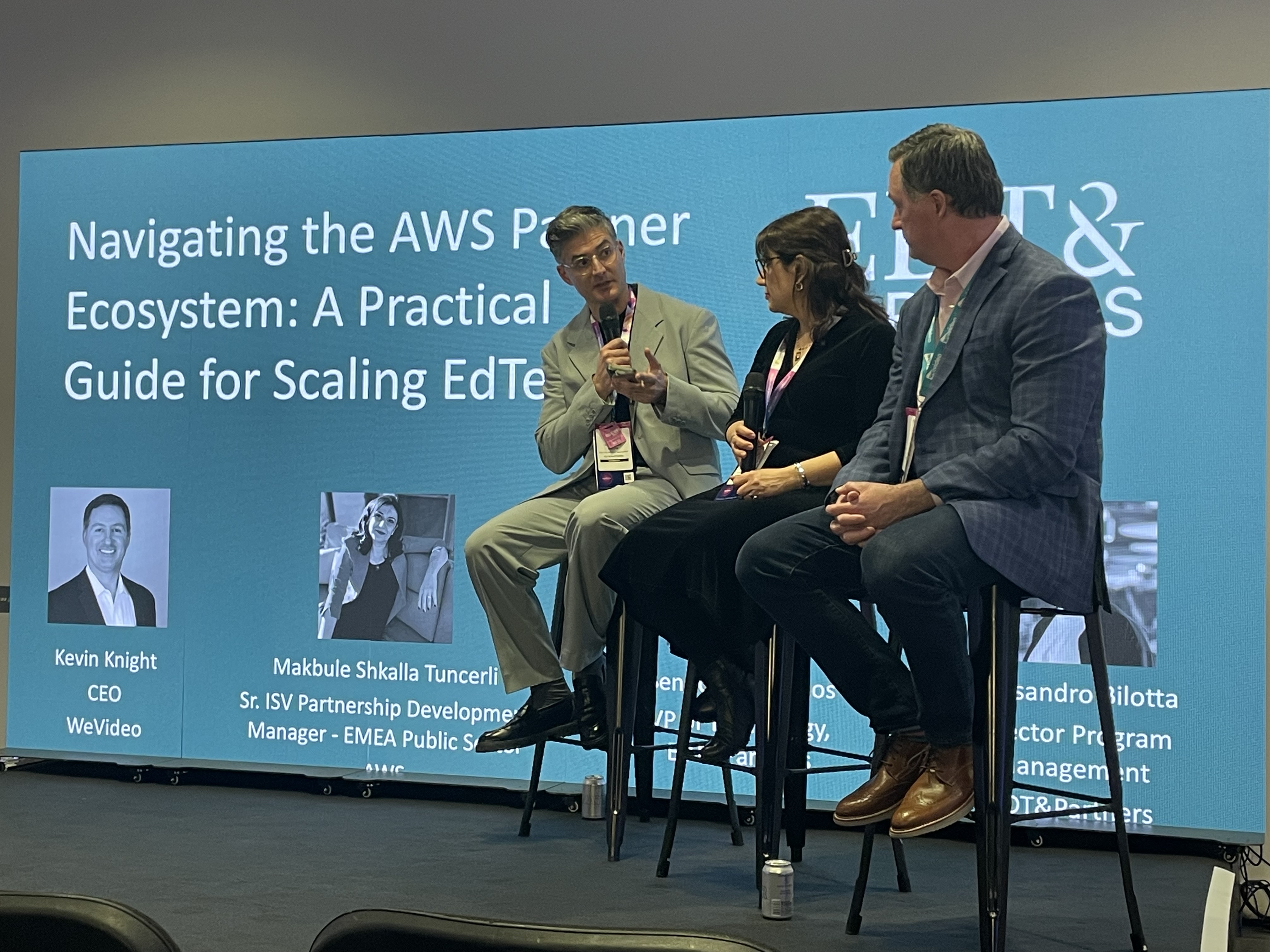
For many education companies, AWS is a critical enabler of scale. But its Partners ecosystem (AWS Partner Network) from programs to co-sell and Marketplace, can be difficult to navigate in practice. This session explored how growing EdTech companies can engage effectively with AWS, move beyond passive participation, and activate the parts of the ecosystem that drive real commercial momentum.
Drawing on perspectives from AWS partnership leadership, an EdTech operator, and advisory experience, the discussion focused on what actually works, where companies often misstep, and how third-party partners can help translate AWS structures into growth.
The session was designed for EdTech founders, CEOs, and growth leaders responsible for cloud strategy, partnerships, and international scale.
Speakers
Kevin Knight, CEO, WeVideo
Makbule Shkalla Tuncerli, Sr. ISV Partnership Development Manager, EMEA Public Sector, AWS
Alessandro Bilotta, Director, Program Management, EDT&Partners
Why This Matters
AWS offers far more than infrastructure, including partner programs, co-sell opportunities, and Marketplace distribution. Yet many education companies fail to realize meaningful value because they engage too early, too broadly, or without clear internal readiness.
The session highlighted a recurring pattern: enrolling in AWS programs does not create impact on its own. Value emerges only when companies understand when to engage, how incentives actually work in practice, and what internal capabilities must be in place to convert participation into revenue, reach, and scale.
Key Themes & Takeaways
1. AWS value is activated, not automatic.
Simply joining programs or listing on Marketplace does not drive growth. Companies must be deliberate about which mechanisms to engage and why.
2. Timing and sequencing matter.
Different AWS programs serve different stages of growth. Engaging too early or without internal alignment often leads to frustration and stalled outcomes.
3. Co-sell and Marketplace are often misunderstood.
Both can be powerful levers, but only when expectations are clear and companies are operationally ready to support them as real channels.
4. Internal readiness determines external impact.
Successful engagement depends on clarity around commercial priorities, product positioning, architecture, and sales enablement, not just cloud maturity.
5. Guidance accelerates outcomes.
Companies that work with experienced partners are better able to translate AWS structures, incentives, and programs into coordinated growth rather than fragmented activity.
Speaker Highlights
Makbule Shkalla Tuncerli, Sr. ISV Partnership Development Manager, EMEA Public Sector, AWS
Shared how AWS empowers ISVs to scale and navigate the partnership ecosystem effectively, from migration and technical enablement to global programs and go-to-market collaboration, emphasising the importance of understanding where each mechanism fits.
Kevin Knight, CEO, WeVideo
Reflected on WeVideo’s experience participating in AWS-adjacent initiatives with EDT&Partners , highlighting what tangibly changed in how the company approached AWS, co-sell, and Marketplace over time, and where having a guiding partner made the biggest difference.
Alessandro Bilotta, Director, Program Management, EDT&Partners
Framed the recurring challenges EDT&Partners sees across EdTech companies, including misaligned incentives, premature co-sell attempts, and Marketplace treated as a checkbox rather than a channel.
Real-World Examples
Program participation with intent.
WeVideo’s engagement in initiatives such as Global Passport and Catalyst illustrated how structured programs can create value when aligned to clear growth objectives.
Co-sell readiness as a prerequisite.
The discussion reinforced that co-sell works best when companies invest upfront in internal alignment, messaging, and enablement, rather than expecting AWS to generate demand on their behalf.
Marketplace as a channel, not a listing.
Marketplace success depends on active management, positioning, and integration into broader go-to-market strategy, not simply being present.
Practical Implications for Leaders
Be selective, not exhaustive.
Choose AWS programs and mechanisms based on your current growth stage and priorities, not because they are available.
Prepare before you engage.
Invest in internal readiness, including commercial clarity, sales alignment, and architectural decisions, before pursuing co-sell or Marketplace.
Set realistic expectations.
Understand what AWS programs can and cannot do, and where responsibility sits with your own team.
Treat Marketplace as a growth channel.
Manage it with the same intent and resourcing as any other route to market.
Use experienced guides.
Partners who understand AWS structures and incentives can help translate complexity into momentum and avoid costly missteps.
3. Scaling with Intent: International Growth Strategies for Education Companies
Thursday, Jan 22 | 11:00 - 11:25 a.m.

Session Overview
Internationalization is becoming an integral part of the long-term strategy for an increasing number of EdTech companies. It is not simply a means of expansion, but a driver of diversification, resilience, relevance across education systems, and sustainable growth.
In this session, Josep M. Mas (EDT&Partners) chaired a practical discussion with two CEOs whose companies have successfully internationalized, as well as a specialist from the UK Department for Business and Trade, on what international growth actually requires in practice.
Topics included the need to embrace a mindset shift (from “exporting” to “operating locally”); what companies should understand by “localization”; the need to manage trade-offs between control, speed, and risk, and what growth may look like in reality (considering maturity, timing, and the management of expectations).
The session was designed with EdTech founders, CEOs, and growth leaders in mind who are considering, or already pursuing, growth beyond their home markets.
Speakers
Josep M. Mas, VP of Consulting & Partner, EDT&Partners
Thea Wiltshire, UK Department for Business & Trade
Matthew Given, CEO, Seesaw
Christopher Bacon, CEO and Co-founder, Komodo
Key Themes and Takeaways
What actually determines whether an EdTech company succeeds or fails when entering a new market?
The session was structured into four blocks, with specific questions addressed to the different panelists. What follows is a summary of the discussion among the speakers.
1. International growth builds on existing strengths, but requires a change in mindset.
The most common failure mode incurred by EdTechs embarking in internationalization is the assumption that domestic success will transfer cleanly into a new context. While it is true that companies rarely start from zero, they should allow sufficient time to reflect on and assess how their product, implementation, and commercial approach translate from one market to another.
Internationalization is not about scaling a domestic model. More often than not, it implies rebuilding, adapting or transforming parts of the business for a different context and system. In this respect, and despite being highly successful in their domestic markets, many companies do not succeed simply because they remain focused on “export mindsets” rather than on selling solutions.
2. The strongest international operators become diplomats inside the system.
Successful companies do more than localize a product. They learn how the system works, who influences decisions, and how educators experience outcomes on a day-to-day basis.
There is frequently a gap between those deciding and procuring which tools should be used, on the one hand, and those using them in a socialization context, on the other. Successful companies that scale internationally are fully aware that these groups vary from country to country and are not always aligned. EdTechs that succeed in other geographies tend to play an active role in bridging that divide, earning credibility with both decision-makers and the educators who ultimately determine adoption.
3. Localization is multi-layered and includes trust, not just language.
Localization is much more than merely translating the UI or backend of an EdTech tool. All panellists coincided in appreciating that localization requires work and attention across four distinct layers:
- Pedagogy & usage (how learning actually happens)
- UX & expectations (teacher and student behaviour; parental and government expectations, and willingness to pay)
- Commercial logic (pricing, contracts, procurement)
- Compliance & trust (data, security, accreditation)
The fact is that even curriculum-aligned products may land very differently from one market to another. Proof points, case studies, and value propositions often need to be adapted to local learning cultures.
4. Route to market is a context-specific set of trade-offs between speed, control, and risk.
The panel reinforced that there is no universal playbook. Routes to market vary based on how decisions are made locally and how much embedded knowledge is required to build trust.
In essence, every route to market is a strategic decision which, more often than not, requires companies to compromise or manage trade-offs. The following examples were mentioned:
- Channel partners optimize velocity and market access at the cost of relinquishing control and accepting lower margins.
- Developing a local team, on the contrary, secures control and market knowledge but drains resources, especially at a time when the team is building the market.
- Acquisitions provide access to a captive market but, in turn, risk diluting the brand.
5. Government-backed ecosystems can accelerate credibility and access.
The UK’s newly launched International Education Strategy was discussed as an example of how government-supported infrastructure can help companies plug into established overseas education ecosystems.
More broadly, curriculum networks, institutional platforms, and trade support can reduce friction for companies expanding internationally, particularly in markets where legitimacy is closely tied to local partnerships and policy context.
6. Growth is slower and less linear than expected, and trust compounds through adoption.
Managing international growth is synonymous with managing serious tensions.
International expansion requires patience. Progress is nearly always slower than expected, patchy and far from linear. Mistakes are inevitable. Schools move cautiously, and legitimacy compounds over time.
One of the clearest indicators of traction is sustained adoption and advocacy: when educators continue using a product because it is embedded in practice, and then recommend it to peers in new settings. While that cannot be forced, it can be supported through strong implementation, teacher enablement, and proof points that are built in local contexts.
EdTech companies also move faster when they bring in experienced local and international professionals who can help them avoid common missteps, navigate decision structures, and build credibility without trying to outrun trust.
Speaker Highlights
Matt Given, CEO, Seesaw
“You need a completely different business model in different regions.”
Matt shared how Seesaw adapts its route-to-market region by region, including an acquisition in the Middle East, to build on embedded local depth.
Thea Wiltshire, UK Department for Business & Trade
“Providing a curriculum-aligned product does not mean it will land the same way overseas.”
Thea emphasised that curricular alignment does not guarantee adoption, and highlighted the UK’s International Education Strategy as an example of ecosystem infrastructure companies can plug into.
Chris Bacon, CEO and Co-founder, Komodo
“If you’re not speaking to schools, you’re failing yourself and the people you’re trying to serve.”
Chris described how operating across 50 countries starts with spending time in-market and practicing active listening, not by making assumptions or rushing into pitch-first expansion.
Josep M. Mas, VP of Consulting & Partner, EDT&Partners
“International schools are not necessarily the golden ticket they may seem.”
Josep cautioned against treating international schools as an automatic entry point, noting that they tend to be the first port of call for companies internationalizing out of the U.S. or Europe, despite representing only a minute fraction of the overall opportunity (barely 1% of the global private school market, and likely less when including the full global long tail of low-cost private schools).
Practical Implications for EdTech Leaders
- Treat internationalization as an evolution of existing strengths, not a geographic rollout.
- Invest early in understanding how local education systems work, including the roles of key personas and the relevance of critical factors in the value chain (decision-makers, users, critical outcomes, and expectations).
- Localize across pedagogy, UX, commercial logic, compliance, and trust.
- Build deliberate routes to market, balancing speed with risk and local depth.
- Measure traction through sustained adoption and advocacy, not pipeline alone.
- Bring in experienced local and international partners to accelerate learning, avoid basic mistakes, and build credibility in-market.
- Focus on earning legitimacy, not simply on establishing a presence in a new market.
4. The Next Operating Model for Education
Thursday, Jan 22 | 4:00 - 4:25 p.m.

Session Overview
Education is under structural pressure, not only from AI, but from disengagement, workforce constraints, and rising expectations that existing operating models were never designed to absorb.
This session explored what the next operating model for education requires at the level of learning design, governance, assessment, and infrastructure, and what this means for leaders making decisions today.
When we talk about an operating model, we mean how learning is organized, supported, governed, and measured at scale, and whether those pieces are aligned with the outcomes education says it values.
The session was designed for school and university leaders, system operators, and policymakers navigating structural change across learning, technology, and operations.
Speakers
Jenny Anderson, Author of The Disengaged Teen
Al Kingsley, CEO, NetSupport; Chair of a MAT
Stuart Briner, Group Head of EdTech, International School Partnerships
Laurie Forcier, VP of Strategy, EDT&Partners
Why This Matters
Most education systems still operate on models built for stability and standardization. But those models are not evolving quickly enough to absorb today’s pressures.
Disengagement, workforce strain, AI, and shifting expectations are being pushed onto leaders and schools to carry individually. Without alignment at the operating model level, innovation remains fragmented, and new technologies risk accelerating existing weaknesses rather than addressing them.
Key Themes and Takeaways
1. The current operating model is not absorbing change.
Current model: Built for stability and standardization. Because it is not evolving, it is not absorbing today’s pressures. Disengagement, workforce strain, and AI are being pushed onto leaders and schools to carry individually.
Next model: Operating models need to be designed to absorb change, with shared structures for learning design, governance, and support, rather than leaving adaptation to individual schools or principals.
2. Disengagement is a design signal, not an individual failure.
Current model: Jenny Anderson shared a stark trajectory: roughly 75% of students report being engaged in 3rd grade, but by 10th grade that figure drops to around 25%. Engagement declines as agency is reduced and learning becomes less relevant.
She also described how disengagement shows up across learner groups:
- about 50% of students are coasting
- around 20% are hyper-achievement oriented
- many are in “resistor mode,” often labeled as behavioral problems
- only about 4% report being deeply motivated by learning itself
Next model: Leaders need to treat disengagement as feedback on system design, and rebuild learning experiences that increase relevance, autonomy, and connection over time.
3. Compliance scales more easily than meaningful learning.
Current model: Systems have become highly effective at standardizing curriculum coverage and compliance, but far less effective at scaling strong learning design.
Stuart Briner noted that across a network of roughly 120 schools, translating what works in one classroom reliably across a group remains a major institutional challenge.
Next model: The next operating model must invest in scalable learning design capacity, not just scalable process.
4. Agency must be built at the system level.
Current model: Agency is often treated as optional, dependent on individual teachers or exceptional schools.
Next model: Agency is a structural requirement. It means autonomy, choice, and respect within clear boundaries. Jenny referenced research showing even modest increases in autonomy improve academic outcomes, persistence, and wellbeing.
A key design principle raised was building for cohesion rather than conformity, shared direction with flexibility in delivery.
5. Governance and assessment are no longer fit for purpose.
Current model: Education systems still measure what was measurable decades ago, even while claiming to value curiosity, resilience, creativity, and critical thinking.
Al Kingsley framed governance simply: who decides, who is consulted, and who is informed. Many systems are not designed to govern for the outcomes they now prioritize.
Next model: Governance and assessment must evolve together, so that what schools measure, reward, and report aligns with what they actually want learners to become.
6. AI must be treated as infrastructure, not a tool.
Current model: AI is often introduced as a productivity add-on. In practice, it quickly behaves like infrastructure, shaping data flows, assessment, safeguarding, and trust.
As Al noted, AI will accelerate whatever operating model is already in place.
Next model: Governance before tooling. Leaders need clarity of purpose, guardrails, transparency, and human oversight before AI becomes embedded across systems.
7. AI is disrupting the shared assumptions between schools and families.
Current model: The operating model has carried implicit assumptions about where learning happens, how success is measured, and where responsibility sits. Parents are often left uncertain about how AI is changing that equation, and many feel in the dark about what students are navigating, especially outside the classroom.
Next model: This cannot remain a school-only issue. As AI reshapes learning inside and beyond institutions, the next operating model will require shared learning, clearer norms, and greater transparency across schools, families, and the broader system as expectations evolve.
Practical Implications for Leaders
- Stop assuming the system can absorb change when evidence shows it cannot.
- Treat disengagement as a design signal, not only a student support issue.
- Invest in scaling meaningful learning experiences, not just compliance.
- Design agency at the system level through cohesion, not conformity.
- Update governance and assessment to reflect the outcomes education claims to value.
- Treat AI as infrastructure and establish guardrails before scaling tools.
- Start with the why before focusing on the what or the how.
- Bring parents into the operating model by clarifying what responsible use looks like at school and at home.
- Do not assume shared understanding. Make the reasoning, trade-offs, and evolving norms around AI visible, treating parent confidence as a governance and trust requirement, not a communications task.
5. Fireside Chat: From AI Hype to Impact: What Real Technology Adoption Looks Like in Education
Thursday, Jan 22 | 4:30 - 4:55 p.m.

Session Overview
As education moves beyond the hype cycle of generative AI, the challenge is no longer experimentation, but adoption at scale. This fireside chat explored what AI and emerging technologies look like in real deployments across K–12, higher education, and EdTech, and what it takes to move from pilots to sustainable systems.
The session was designed for education and EdTech leaders responsible for strategy, technology adoption, governance, and implementation at scale.
Speakers
Valerie Singer, General Manager, Global Education, Amazon Web Services (AWS)
Pablo Langa, Founder & Managing Partner, EDT&Partners
Why This Matters
As AI moves from experimentation to everyday use, the challenge for education is no longer access to tools, but adoption with impact. AI is increasingly shaping core systems, including assessment, data, safeguarding, and trust, which means success depends less on innovation speed and more on governance, skills, and deployment context.
The conversation highlighted a defining tension for the sector: it has never been easier to build technology, yet never harder to scale it responsibly. Moving beyond hype requires aligning learning outcomes, operational realities, and regulatory expectations, rather than treating AI as a standalone solution.
Key Themes & Takeaways
1. Purpose beats hype.
The initiatives gaining traction are built around learning outcomes and learning science, with compliance and infrastructure treated as core design requirements, not an afterthought.
2. AI is infrastructure, so governance comes first.
As AI scales, it shapes data flows, assessment, safeguarding, and trust. Adoption depends on having governance models that can manage tools, agents, and integrations responsibly.
3. ROI is emerging first through efficiency, with learning impact still catching up.
Early value is showing up in time savings and operational gains. Measuring student impact remains harder, context-dependent, and requires more longitudinal evidence.
4. Build for global realities: modularity and regulatory readiness.
To scale across regions, products need modular architectures that can adapt to data residency, digital sovereignty, and shifting model and compliance requirements without constant rework.
5. Adoption is constrained by skills and responsibility, not just technology.
AI literacy gaps among educators and leaders are slowing scale. At the same time, safety, privacy, and safeguarding must be non-negotiable as tools move into everyday learning environments.
Speaker Highlights
Pablo Langa
“We are moving into a direction where actually more purposeful initiatives will separate what has impact from what is just hype.”
Pablo emphasized that the next phase of AI adoption in education will be defined by intent and design discipline. The initiatives most likely to scale are those anchored in learning outcomes and learning science, and built with compliance, security, and infrastructure as core requirements rather than secondary considerations.
Valerie Singer
“The most effective solutions are the ones that empower teachers rather than replace them.”
Valerie highlighted that meaningful adoption depends on designing AI to strengthen human decision-making. The strongest use cases wrap around educators and learners, promoting critical thinking, professional judgment, and responsible use, while ensuring flexibility and safety at scale.
Real-World Examples & Signals from the Field
AI supporting teachers, not replacing them.
Learnocity’s Learning Mate was referenced as an example of AI designed to assist teachers with assessment, while keeping professional judgment and feedback firmly human-led.
Using AI to improve quality, not just efficiency.
A UK university shared how AI is being used to review long-form assessment feedback for bias and inconsistency, demonstrating value beyond automating marking or grading.
Tool sprawl as a scaling risk.
The discussion highlighted the reality of crowded ecosystems, with hundreds of tools in a typical school or district. This reinforced the need for intentional adoption, clear priorities, and governance to avoid fragmentation.
Questions Raised from the Audience
What happens when AI causes harm?
A university CISO raised concerns about safety, safeguarding, and real-world risks. The response emphasised that responsibility is shared: providers must design with guardrails and transparency, while institutions must scrutinise learning evidence, data flows, and privacy protections.
How can teachers innovate when assessment systems lag behind?
A teacher development lead highlighted the tension between being asked to innovate with AI while still being measured against traditional qualifications and metrics. The discussion pointed to the absence of standardised AI literacy frameworks and the need for sector-wide progress on confidence and capability building.
Practical Implications for Leaders
Start with purpose, not possibility.
Be explicit about what AI is meant to improve, whether efficiency, teaching practice, learner outcomes, or wellbeing, and how success will be measured in your context.
Treat AI as infrastructure.
Plan governance, security, privacy, and integration before scaling pilots. AI will shape systems, not sit alongside them.
Design for change and regulation.
Build or select solutions with modular, flexible architectures that can adapt to evolving models, compliance requirements, and regional constraints.
Invest in skills alongside tools.
AI literacy for educators, administrators, and implementation teams is a prerequisite for impact, not a downstream activity.
Shift the screen-time debate to screen value.
Focus on when and why technology is used, ensuring tools support human development, critical thinking, and engagement rather than passive consumption.
EDT&Partners
The EDT&Partners Editorial Team brings together education and technology experts sharing insights, stories, and strategies shaping the future of learning.
Join our newsletter
Be part of our global community — receive the latest articles, perspectives, and resources from The EDiT Journal.

.png)
.png)